How do waves cross the pile?

Carefully....😉 But it is much more complicated than that, because physics dictates the answer. For 30 years, we have been making the CSL system (CHUM), but only recently, with the help of AI, have we managed to build a simulator to demonstrate it.
Why should you care?
If you are conducting crosshole sonic logging (CSL) tests, then you should.
So, to make it easier, I used this Q&A style of a blog to cover the different interesting aspects of that issue.
Q: What is the Max Distance allowed between CSL tubes?
A: The wave can travel long distances... I once got a good signal from 6m element. But the waves can go around defects, and the added travel time can be shorter than the background noise. It is common to say that a defect halfway between the tubes (worst case) has to be 30% the tube distance to be discovered.
In a 6m distance, that's a car-sized defect... So typical distances are more like 1m
The rule of thumb says: One CSL tube per One foot (30cm) of pile diameter, so a 1.2 m pile usually gets 4 access tubes.
Q: Does concrete strength affect wave propagation
A: Not really. Concrete needs to be fairly mature, not just because of wave speed, but also because different areas in the pile cure at a different rate (due to temperature differences, different retarder mix in different trucks, etc), and it takes 5-7 days for the concrete to become homogeneous. This ensures that waves traveling throughout the pile travel similar distances for a given period of time, which the CSL test method relies on. Use the simulator below to see this in action.

Q: How does aggregate size affect the CSL test?
A: That depends on the frequency: lower frequency = lower resolution and larger aggregates. In our case, 50 kHz in typical 4400 m/s concrete will have an 88 mm wavelength; concrete with aggregates larger than that will attenuate the signal significantly. That is the "knee" in the attenuation curve. It's not linear
Q: In the same profile, some FATs are larger than others?
A: FAT stands for First Arrival Time. Since the wave velocity in cured concrete is about 4300m/s ( /- 10%), it will take the wave 1ms to pass 4.3m, 500us to pass 2.15m, and 250us to pass 1.075m, etc. Since sections are never at the exact same distance, it is expected that the FAT will change.
Q: What is the range of values of FAT &Attenuation for good & bad piles?
The received signal has measurable energy. The energy drops exponentially as the distance grows. It is expected for the energy to remain roughly constant in homogeneous concrete. Attenuation is simply the energy in decibels (DB) units, relative to the maximal energy that can be recorded. A change of 6db means half the energy. 12db is 1/4 the energy, etc.
Q: The CHUM results is not showing the exact spacing between the sonic tubes
A: In the leveling screen, the distance is only an estimate (this is why it has the ~ sign next to it). CHUM can only measure time, not distance! The distance is calculated assuming a signal velocity of 4300m/s. In your case, the signal velocity might be lower - the concrete might be too fresh or of lower grade/quality. Anyway, the distance value is presented on this screen in order to help you level the pulses, not for reporting.
Q: Why a number of the traces show a very large drop in the relative energy, but little or no change in the FAT?
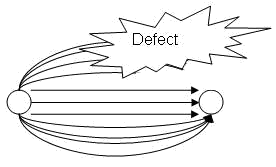
A: A weaker signal with no change in FAT can be generated when the wave path becomes smaller, for example, in the case of a necking. As seen in this image, the shortest path between source and receiver is not disturbed; therefore, the FAT shows no indication of the defect. However, the total amount of energy reaching the receiver is significantly reduced. This is just one way of explaining this phenomenon. I am not aware of any research done to quantify it or find additional explanations. There is no way to assess the size and severity of the defect (if it is indeed a defect) from this trace, but you quite confidently assess that if the energy dropped significantly (say by 18 db or more in the attenuation curve) you are not crying wolf.
Q: In general, the traces are quite smooth (about a vertical line), but every now and then the line is very jagged, although still about a vertical line. Does this sound like a problem?
A: Concrete is not a homogeneous material, and some variations of the FAT and attenuation are to be expected even in the most controlled environment. Unless you can see a significant change in FAT or energy (And I cannot quantify this change), you are safe.


Comments