Inside the Test Kit: What to Look For When Buying Pile Testing Equipment

Updated: Aug 11
Every reputable pile integrity tester and cross-hole logging system on the market complies with the same core standards - ASTM D5882 for Pile Integrity Testing (PIT) and ASTM D6760 for Cross-Hole Sonic Logging (CSL). That compliance is the entry ticket, not the differentiator. Two devices can both pass the same standard and still produce wildly different results in the field: one costs you an extra hour per shift, the other pays for itself in a single 100-pile job. This guide breaks down what actually separates pile testing equipment once you look past the compliance checkbox - using Piletest's PET (ASTM D5882) and CHUM (ASTM D6760) as the reference point.
Below are images of PET USB, PET BT, and the CHUM CSL system.
Compliance Is the Floor, Not the Ceiling
Buyers often shop for pile testing equipment the way they'd shop for a commodity: check the ASTM number, compare price, done. But ASTM D5882 and D6760 define minimum data-quality requirements - they say nothing about how long it takes an operator to collect that data, how much rework happens back in the office, or how many piles a single crew can realistically test in a working day. On a large project with hundreds of piles, that operational gap is where budgets and schedules are actually won or lost.
The right question isn't "does it comply?" - every serious vendor's kit does. The right question is: how much operator time and office time does this kit save per pile, per shaft, per day?
What to Look For in a PIT/PET Kit (ASTM D5882)
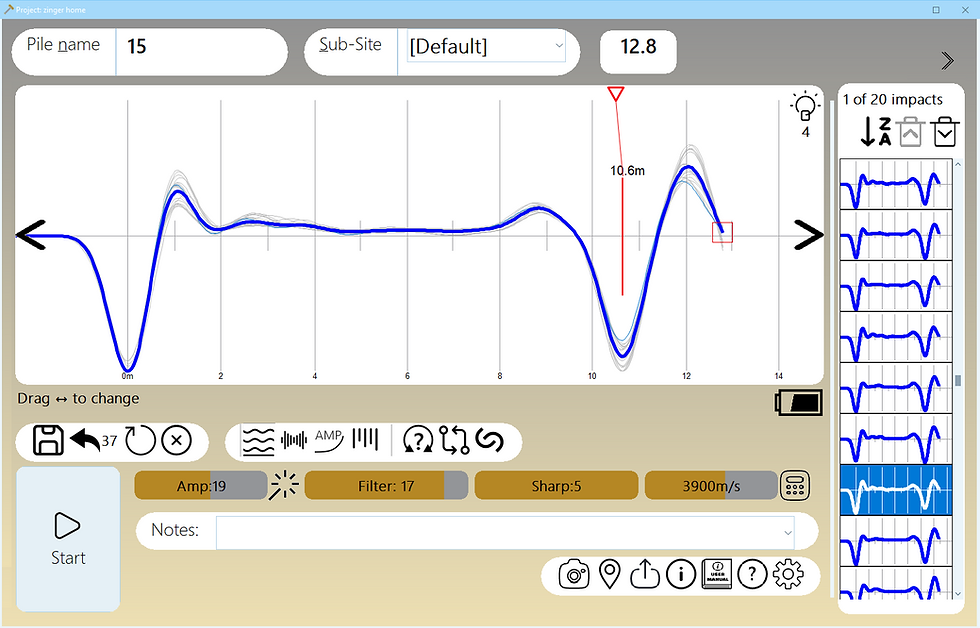
The Pile Integrity Test (PIT), performed with a Pile Echo Tester (PET), uses the pulse-echo method: a hammer strike generates a stress wave down the shaft, and an accelerometer captures the reflection to reveal defects, length variation, and construction anomalies. Under good conditions, this method can move fast - but only if the equipment is built to keep pace with the operator, not slow them down.
Look for these efficiency features:
SmartTrigger. Manually moving around a pile head triggers plenty of false impacts from stray accelerometer movement. SmartTrigger technology analyses the shape of each trigger and filters out false strikes automatically, so operators can set a low, sensitive trigger threshold and still get clean data from fast, light hammer taps - without constant manual filtering of noisy impacts/reflectograms.
Auto-Sort. Rather than keeping every irregular impact, Auto-Sort lets the operator define a target number of good impacts; once that count is reached, the system automatically discards the most inconsistent traces. This turns a noisy set of hammer strikes into a clean, averaged reflectogram without any manual cleanup.
Convergence indicators. A built-in signal that tells the operator, in real time, when enough consistent impact data has been collected - so testers stop guessing how many hammer strikes are "enough" and move to the next pile as soon as the data is solid.
Bulk insert / mass data entry. For large projects with repetitive pile layouts, bulk insert lets an operator define an entire numbered series of piles in one step instead of typing each one individually - cutting setup time dramatically on projects with dozens or hundreds of shafts. See our full breakdown of PET's productivity features for a real-world example of testing a 100-pile retaining wall in half the expected time.
Rugged, wireless field design. Bluetooth connectivity to a tablet or phone, an IP68 durability rating that translates to a 3-year warranty, and battery-swappable power mean testing doesn't stop for cables, weather, or charging cycles. Our time-saving tips for PIT testing with PET go further into site-preparation and workflow habits that push throughput toward 100 piles per hour for a single operator.
Pile fixed identity – As the software runs on your Android smartphone, it also integrates with its camera and GPS, which allows you to tag each pile with its picture and location, and present its location on a Google Maps site image.
Below are images from Google Maps. Streetview is old, and shows where the piles where catsed on the plain land, the Stareet Map (center) shows their clear location, and the Sat Image from the intial building stage, preents their location under the house they support
None of these features change whether the device meets ASTM D5882 - they change whether your crew tests 30 piles a day or 100.
What to Look For in a CSL Kit (ASTM D6760)
Cross-Hole Sonic Logging evaluates the internal condition of a cast pile by sending ultrasonic pulses between probes lowered through pre-installed access tubes, capturing arrival time, signal energy, and waveform data at each depth. Because CSL directly measures the concrete rather than inferring its condition, it has become the accepted benchmark for internal defect detection - but the throughput of that measurement method depends heavily on the instrument behind it.
Look for these efficiency features:
High pull speed without signal loss. The CHUM system achieves a pull speed of 2 meters per second by sending and measuring 40 signal pulses per second with a high signal-to-noise transceiver design - instead of forcing operators to pull probes slowly to avoid noisy waveforms.
Real-time Automatic Gain Control (AGC). Concrete density, tube debonding, and shifting tube spacing all change signal attenuation as the probe moves. AGC adjusts amplification dynamically during the pull, so the operator never has to stop and manually recalibrate gain mid-test. Note that keeping full gain all the time also keeps noise at full gain, so this is not a good practice. AGC automatically chooses the optimal gain value.
A short, structured test wizard. A CSL kit that needs deep menu-diving between every shaft eats time across dozens of piles. A streamlined setup - CHUM's is a 3-click wizard - turns configuration into a non-issue. In addition, zero setup time for the sensors' depth meter & pulley.
Edge processing: automated FAT and instant tomography. Post-processing is traditionally where CSL projects lose the most time. Automated First Arrival Time (FAT) picking and on-site 2D tomography let engineers verify shaft integrity before ever leaving the site, instead of waiting for office analysis. Below are images of 3D and 2D tomography.
Real-time severity classification. Rather than exporting raw waveform data for someone else to interpret later, look for software that automatically compiles Relative Energy and FAT graphs into a red/yellow/green severity map, flagging problem zones immediately.
Standard PC-based architecture. Hardware that connects via USB to a normal Windows laptop, rather than a proprietary embedded processor, means the software isn't bottlenecked rendering complex waterfall diagrams or multi-tube data sets. It also allows true multilingual support in the software and while preparing the report in your local language.
Reliability – Running the software on a standard computer allows you a quick switch to a replacement if it fails (also to upgrade to better visibility screen technology). Every sensor is tested to 16ATM waterproof pressure; its depth meter is IP68, and its cable is Kevlar-strengthened for a high-durability sensor system, complementing the standard 3-year warranty on the system.
Our detailed time-saving tips for CSL testing with CHUM show how these features combine to reach up to 700 meters of CSL logging per hour, and as much as 4,500 meters per day for a single operator - output that has nothing to do with meeting ASTM D6760 and everything to do with kit design.
Comparing Beyond Compliance: PET and CHUM at a Glance
Capability | PET (ASTM D5882) | CHUM (ASTM D6760) |
Core efficiency feature | SmartTrigger + Auto-Sort | AGC + automated FAT picking |
Setup time reduction | Bulk insert (up to ~50% faster setup) | 3-click test wizard, zero setup time for depth meter & pulley |
Field data confirmation | Convergence indicator | Instant on-site 2D tomography |
Throughput benchmark | Up to 100 piles/hour, single operator | Up to 700 m/hour, 4,500 m/day |
Report output | Field-ready reflectogram data | Native .docx report generation on-site |
Why This Matters When You're Buying
When evaluating pile testing equipment, ask the vendor to walk through exactly how the device reduces operator decision-making in the field and how much manual work is left for the office afterward. A kit that requires manual trigger tuning, manual gain adjustment, one-by-one pile entry, or full office reprocessing before a report can go out will always cost more in labor hours than its purchase price suggests - no matter how well it complies with ASTM D5882 or D6760.
FAQs
Does ASTM compliance guarantee a pile testing kit is efficient?
No. ASTM D5882 and D6760 set minimum data-quality requirements, not operator speed or workflow efficiency. Two compliant kits can differ enormously in how many piles or meters a crew can test per day.
What is SmartTrigger and why does it matter for PIT testing?
SmartTrigger automatically detects valid hammer impacts and filters out false triggers caused by stray accelerometer movement, letting operators use fast, light taps while maintaining clean, consistent data.
How much faster is CSL testing with automated features like AGC and 3-click setup?
With real-time Automatic Gain Control and a streamlined test wizard, systems like CHUM can sustain a 2 m/s pull speed and up to 700 meters of CSL logging per hour, largely by a sensitive, fast sensor system and by removing manual recalibration and menu navigation from the workflow.
Can pile testing equipment reduce office/post-processing time?
Yes. Features like automated First Arrival Time (FAT) picking, instant on-site tomography, and native report generation shift analysis into the field, cutting or eliminating the office hours normally needed after a day of testing.
What's the difference between PET and CHUM?
PET performs Pile Integrity Testing (PIT) under ASTM D5882 using the pulse-echo method to check pile length and detect defects from the pile head for small to midsize deep pile foundations. You can check if your pile fits the pile integrity test method here.
CHUM performs Cross-Hole Sonic Logging (CSL) under ASTM D6760, using ultrasonic transmission between access tubes to directly assess internal concrete integrity, for mid- to large-size deep pile foundations.
What should I prioritize when comparing pile testing equipment from different suppliers? Beyond ASTM compliance, prioritize features that reduce manual intervention: automated triggering and data sorting, real-time gain control, fast setup workflows, and on-site processing - since these directly determine daily testing throughput and total project cost.


Comments